Services / Binding & Finishing
Binding and finishing for complete publications.
Our substantial capacity means we can confidently meet your scheduling needs, whether you have a small project or a large run requiring several machines at once.
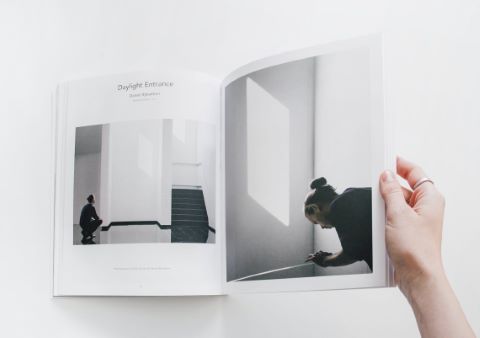
Finishings and specialty printing
We offer various finishings and specialty printings.
We have a multitude of state-of-the-art saddle stitchers and perfect binders.
Binding and coating
Saddle stitched binding, perfect binding, PUR perfect binding, metallics, fluorescents, PMS colors, laminate with various kinds of film, hot foil stamping, and hole punching.
Special finishing
Multiple folding options, UV inks and coatings, spiral binding, embossing, die cutting, and shrink wrapping.
Finishing
Binding methods and file considerations.
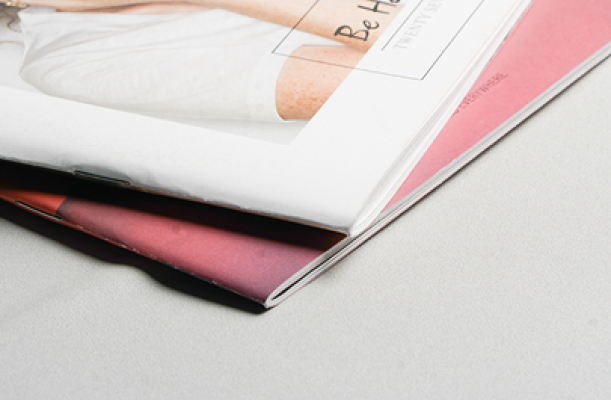
Saddle Stitching
A saddle-stitched publication has all sides of the pages trimmed except the spine. This is to make all the outside edges even.
The "creep" causes the pages to protrude differently as the pages closest to the center will protrude more than the pages on the outside.
If the elements are too close to the outer edge of the page, they may be trimmed off when we trim the pages to avoid a noticeable creep.
Saddle-stitching is ideal for those who opt for a self cover, are using a low paper weight, or have a small amount of pages to be bound.
The process is to staple the pages in the center of the binding. It is most commonly used for catalogs and thin magazines.
Saddle-stitch requires that pages be in multiples of 4. Files for the pages and covers should be submitted as single pages.
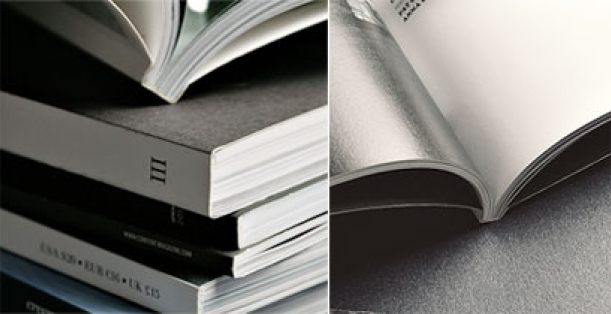
Perfect Binding
A perfect bound publication has all sides of the pages trimmed even at the spine.
This called the "grind". The pages are "ground-off" to insure that the inside pages' edges are all even.
Perfect binding glues all of the pages to the spine of the cover. The result is a completely even edge on the outside.
This binding is optimal for those with many pages and a heavier paper weight cover. It is commonly used for higher volume magazines and luxury catalogs.
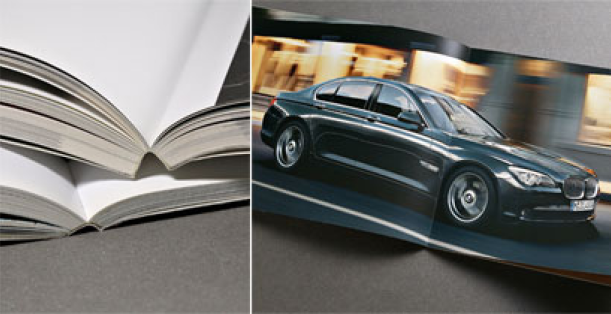
PUR Perfect Binding
PUR (polyurethane reactive) binding follows the exact same process as perfect binding except we change the glue from Perfect Binding Adhesive to PUR Adhesive by exchanging the glue pots.
PUR glue reacts with the moisture content in the paper and the chemical reaction creates a much stronger bind than the conventional glue.
PUR is the strongest, most flexible binding adhesive available.
The thin, tough, and flexible consistency of PUR enables the magazine to open easily and can lay open flat. It's the optimal choice for projects that will see frequent use and demand durability.
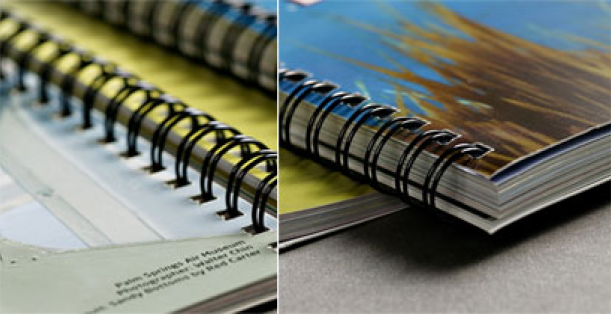
Spiral Binding
A spiral binding consists of a continuous wire, which is coiled through evenly spaced holes that have been punched into the pages of a book.
The spiral wire can be made of metal, plastic, or plastic coated metal.
When the books are open, the pages lie flat. The pages can also be folded over completely, which makes spiral binding a good choice for training manuals, cookbooks, notebooks, and calendars.
Print Coating
Coatings protect pages and change the final feel.
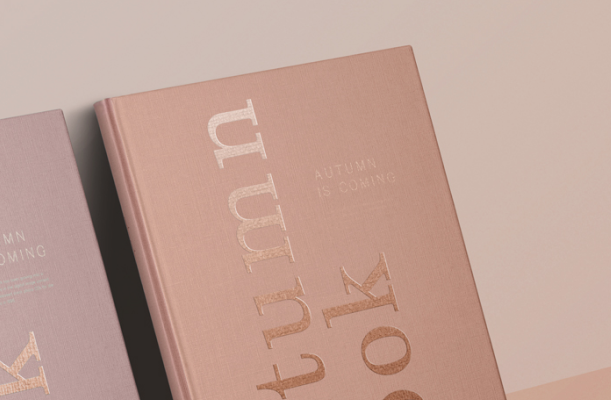
Print Coating
Coatings are applied to protect the printed pages from moisture, extreme temperatures, scuffs, scratches, and frequent handling.
They are also used to draw the eye to a particular element on the page.
We offer four types of print coatings: overprint varnish, aqueous coating, lamination, and UV coating.
All four are available in matte, dull, satin, and glossy.
Please note that coatings appear differently on uncoated paper versus coated paper.
If you plan on writing or rubber stamping on your publication, we suggest not using any coating as it will limit your ability to write on the paper.
Laminate
Lamination comes in two types, film-based and liquid-based. Either a clear plastic film is laid down over the sheet of paper or a clear liquid is spread over the sheet and dries like a varnish.
Liquid lamination protects paper from water but is slow to apply and is costly. However, it provides a strong, washable surface.
Film lamination features a high gloss finish with a very smooth, tough finish. It will not yellow with age, flake off, and is scratch resistant. In addition, the ink is protected from cracking and provides an odorless/wipeable surface.
UV Coating
Ultra-violet coating is the glossiest coating available and is less commonly available in dull and matte.
UV coating is a clear liquid that is spread over the paper like ink. It can be used as a spot covering to accent a particular image or logo on the page or as a full page coating.
UV coating gives more protection and shine than varnish or aqueous coating. Keep in mind that this thick coating may crack when scored or folded.
Aqueous Coatings
Aqueous coatings are water-based and are applied by an inking unit of the press or in a special coater.
Aqueous dries immediately and has glossy characteristic that falls between varnish and UV coating.
Since aqueous can be applied over wet ink, can seal the printed sheet, and can dry immediately, it has the practical advantage of reducing handling time for trimming and other post-press operations.
Aqueous coating is only recommended for coated sheets as it will be absorbed by uncoated paper stocks.
Special finishing
Special effects for covers and printed pieces.
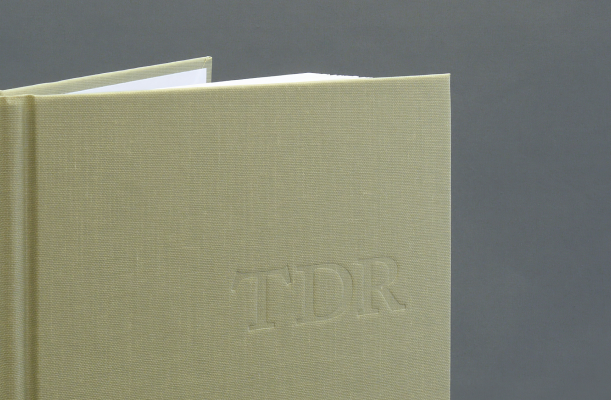
Foil stamping, embossing, die cutting, and Pantone color.
These finishes can add metallic detail, tactile contrast, custom cut shapes, and brand-specific color control to printed pieces.
Foil Stamping
When a print project needs an elegant, non-tarnishing metallic finish to be applied to paper, it is done using a process referred to as foil stamping or hot stamping.
A wide selection of foil colors, finishes, and effects are available such as gold, silver, colored metallics, marble, leather, wood, snakeskin, and pearl finishes.
Embossing
Embossing applies pressure to the backside of paper to alter the surface, giving it a three dimensional or raised effect. It is often used in combination with foil stamping.
The procedure involves two dies, one fitting into the other so that the raised die forces the paper into the recessed die to create the embossed impression.
Generally, embossing is used to attract attention or convey a high quality textural contrast. Debossing is also available as the opposite effect.
Die Cutting
Die cutting is the process of cutting shapes from sheets by pressing a shaped knife edge into layers of sheeting.
The main method involves metal dies that give paper specific cut out shapes or designs that cannot be accomplished with a straight cut on a guillotine cutter.
Pantone Color
Pantone, or PMS, color is any color that is used on a document that is not a process color.
These are often used to create special effects or to meet a company's branding standards with a specific color.
Specialty inks can range from fluorescent, fade resistant, opaque, and metallic.
